Roth IRA Conversion Calculator: See If Converting to a Roth Makes Sense
Find out how converting your traditional IRA or 401(k) to a Roth IRA could affect your retirement savings. Enter your numbers below to compare paying taxes now versus paying them later.
- Updated for 2026 tax brackets.
- Free to use.
- No sign-up needed.
How the same money plays out under three strategies:
The “tax invested separately” scenario assumes the tax money you didn’t spend is invested in a taxable account (gains taxed at ~15% at the end). Estimates are for planning only.
Converting tends to pay off if your future tax rate ends up above this.
Due for the tax year you convert.
Roth withdrawals are tax-free, so the orange bars stay the same height. Traditional bars shrink as future tax rates rise — where they’d match is your break-even. Drag the slider to test any rate.
| Your information | Impact on the results |
|---|
A Roth conversion moves money from a traditional IRA, SEP IRA, SIMPLE IRA, or old 401(k) into a Roth IRA. You pay tax on the amount you convert today, but after that, your money grows completely tax-free. This calculator compares converting versus leaving your money where it is, so you can see which option leaves you with more at retirement.
A Roth IRA conversion calculator estimates whether moving money from a traditional IRA or old 401(k) into a Roth IRA will leave you better or worse off at retirement. It compares your current tax rate to your expected tax rate later and shows the long-term difference between paying taxes now and paying them when you eventually withdraw the money.
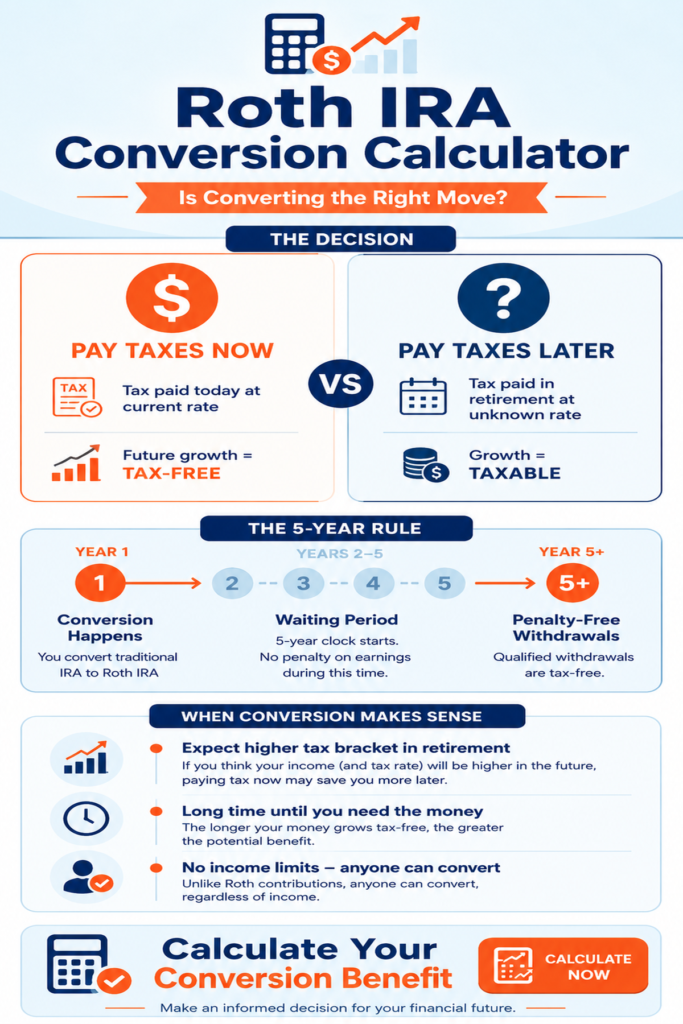
Roth IRA Conversion Calculator: Is Converting the Right Move?
A Roth conversion is a bet on your own future tax rate. Pay taxes on the money now, at today’s rate, and every dollar of growth after that is yours tax-free. Wait, and you’ll pay taxes later instead, whatever the rate happens to be by then. Neither choice is automatically right. It depends on your income now, what you expect to earn later, and how long your money has to grow before you touch it.
This page walks through how the calculator works, how conversion taxes are calculated, and when a conversion tends to make sense.
Key Takeaways
What This Roth IRA Conversion Calculator Checks?
Here’s what each input means and why it matters:
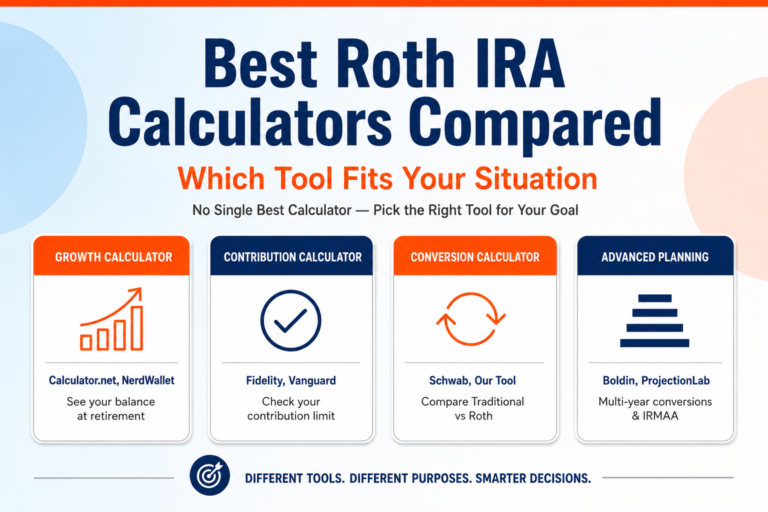
Once you enter these, the calculator shows whether converting leaves you ahead or behind compared to leaving the money in a traditional account. If you’d also like to check your contribution limit for new Roth IRA deposits, try our Roth IRA contribution calculator, or see our Roth IRA calculator to project regular Roth IRA growth over time.
What Is a Roth IRA Conversion?
A Roth IRA conversion means moving money from a pre-tax retirement account, like a traditional IRA, SEP IRA, SIMPLE IRA, or an old employer plan, into a Roth IRA. Because that original money was never taxed, you owe ordinary income tax on the amount you convert in the year you do it.
Before 2010, only people earning under $100,000 could convert. That income limit was removed starting in 2010, so today, anyone can convert regardless of how much they earn. This is exactly why a backdoor Roth IRA works as a strategy for high earners who are locked out of contributing directly.
Converting a 401(k) to a Roth IRA
Many people considering a 401k to Roth IRA conversion are rolling over an account from a previous employer. You can generally convert an old 401(k) directly into a Roth IRA in one step, or roll it into a traditional IRA first and convert from there.
The tax treatment works the same way as an IRA conversion: you owe ordinary income tax on the pre-tax portion you convert. If your old 401(k) included any after-tax contributions, those are usually not taxed again on conversion, but the earnings on them are.
A 403(b) or governmental 457(b) plan can typically be converted the same way, so the numbers on this calculator work whether you’re converting an IRA or an old employer account.
How Roth Conversion Taxes Work?
The amount you convert is added to your taxable income for the year, and taxed at your ordinary income tax rate rather than a special conversion rate. A large conversion can push part of your income into a higher tax bracket, so it’s worth checking where the converted amount lands before committing to it.
If your traditional IRA includes non-deductible contributions, meaning money you already paid tax on, you can’t simply convert just that portion tax-free. The IRS uses what’s called the pro-rata rule, which treats all of your traditional IRA money, deductible and non-deductible combined, as one pool. Your conversion is taxed based on the ratio of pre-tax to after-tax money across all of your IRAs, not just the account you’re converting from.
It’s generally best to pay the tax bill on a conversion using money from outside the account, such as a regular savings or brokerage account. Using IRA funds to pay the tax reduces how much actually makes it into your Roth IRA to grow tax-free, and if you’re under 59½, that amount may also trigger an early withdrawal penalty.
2026 Federal Income Tax Brackets
Since your conversion is taxed at your ordinary income rate, it helps to know where your income falls on the 2026 brackets.
|
Tax Rate |
Single |
Married Filing Jointly |
|
10% |
$0 – $12,400 |
$0 – $24,800 |
|
12% |
$12,400-$50,400 |
$24,800-$0 – $100,800 |
|
22% |
$50,400-$105,700 |
$100,800-$211,400 |
|
24% |
$105,700 – $201,775 |
$211,400 – $403,505 |
|
32% |
$201,775 – $256,2255 |
$403,550 – $512,450 |
|
35% |
$256,225 – $640,600 |
$512,450 – $768,700 |
|
37% |
Over $640,600 |
Over $768,700 |
Head of household and married filing separately follow their own versions of these brackets, generally falling between the single and joint numbers.
When Does a Roth Conversion Make Sense?
As a general rule, converting tends to work in your favor if you expect to be in a higher tax bracket in retirement than you’re in today. Common examples include people early in their careers who are currently in a low bracket, or people with a year of unusually low income who want to convert while their tax rate is temporarily down.
Converting tends to make less sense if you’re currently in your peak earning years and expect a lower tax rate in retirement, since you’d be paying a higher rate now for no real benefit later.
Time also matters. The longer your converted money can stay invested before you need it, the more time it has to grow tax-free and make up for the upfront tax bill. A conversion just a few years before retirement has less time to pay off than one made decades earlier.
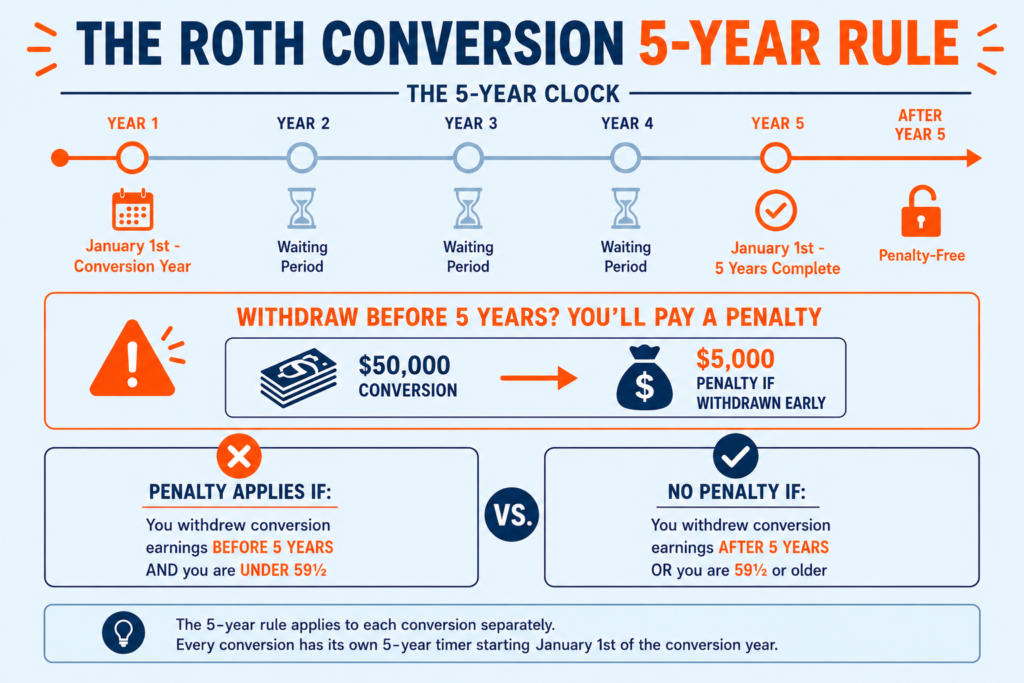
The Roth Conversion Five-Year Rule
Each Roth conversion starts its own separate five-year clock, counted from January 1st of the year you convert. If you withdraw converted funds before those five years is up and before age 59½, you may owe a 10% early withdrawal penalty on that portion, even though you already paid income tax on it at the time of conversion.
This is different from the five-year rule that applies to your Roth IRA as a whole for tax-free earnings withdrawals. If you make conversions in multiple years, each one is tracked separately.
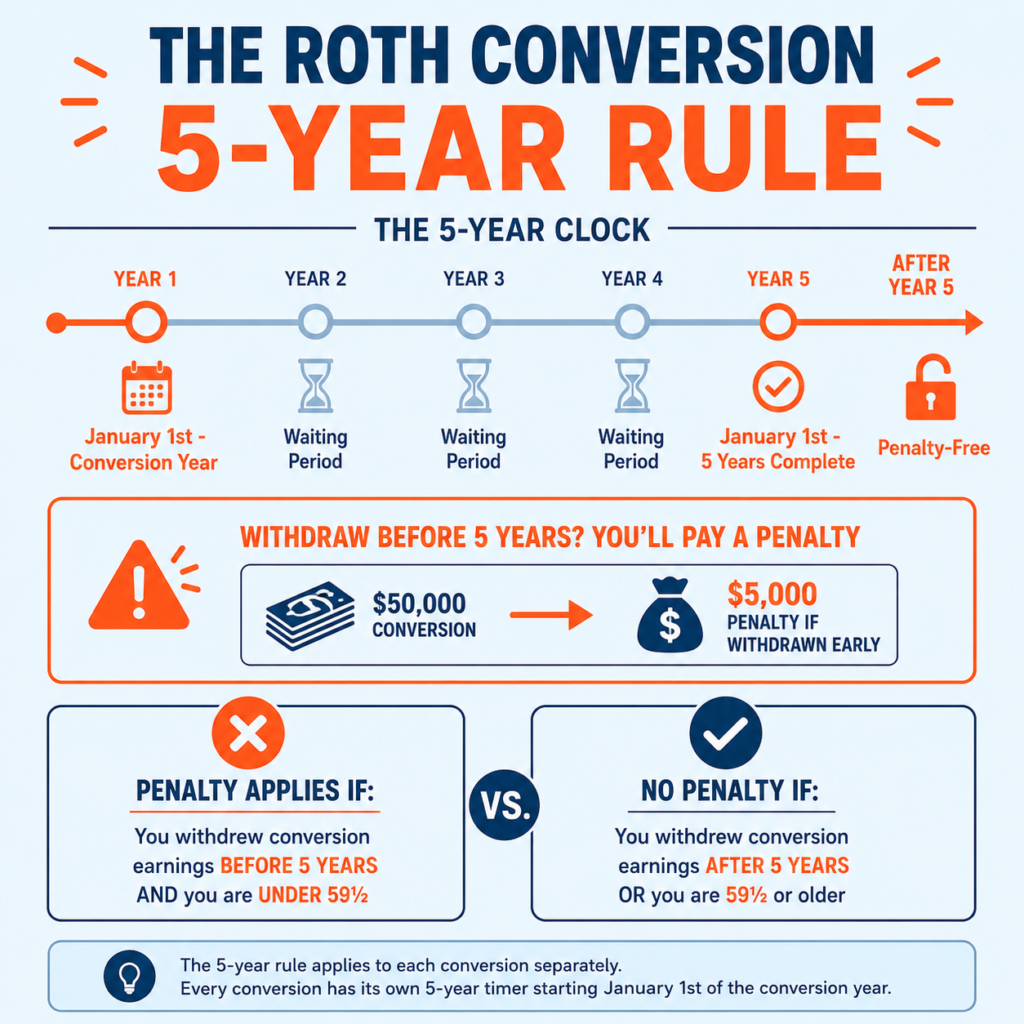
Roth Conversion Ladders
A Roth conversion ladder is a strategy some early retirees use to access retirement funds before age 59½ without paying the usual early withdrawal penalty. It involves converting a portion of a traditional IRA to a Roth IRA each year, then waiting five years before withdrawing that specific converted amount penalty-free. Done consistently over several years, it creates a steady “ladder” of converted funds becoming available one batch at a time.
Frequently Asked Questions
The Bottom Line
Whether a Roth conversion makes sense really comes down to your own tax situation now versus later. Use the calculator above with your own numbers to see the real difference, and talk to a tax professional before converting a large amount.