Tool
Thinking about pulling money out of your Roth IRA? Enter your age, how long you’ve had the account, and how much you want to withdraw to see if you’ll owe any tax or penalty, and how much you’d actually walk away with.
Enter your details above to see your exact withdrawal amount after taxes and penalties.
Are Roth IRA withdrawals taxed?
Withdrawals of your original Roth IRA contributions are always tax-free and penalty-free, no matter your age. Withdrawals of your earnings are only tax-free and penalty-free if you’re 59½ or older and your account has been open at least 5 years. Earnings withdrawn before that are generally hit with income tax plus a 10% early withdrawal penalty, unless an exception applies.
It depends on what you’re withdrawing. A Roth IRA holds two kinds of money: the contributions you put in (already taxed) and the earnings those contributions have grown into (never taxed yet). The IRS treats these two very differently when you take money out.
Contributions: always tax-free and penalty-free, at any age, for any reason.
Earnings: tax-free and penalty-free only if the withdrawal is “qualified”, meaning you’re 59½ or older and the account has been open at least 5 years.
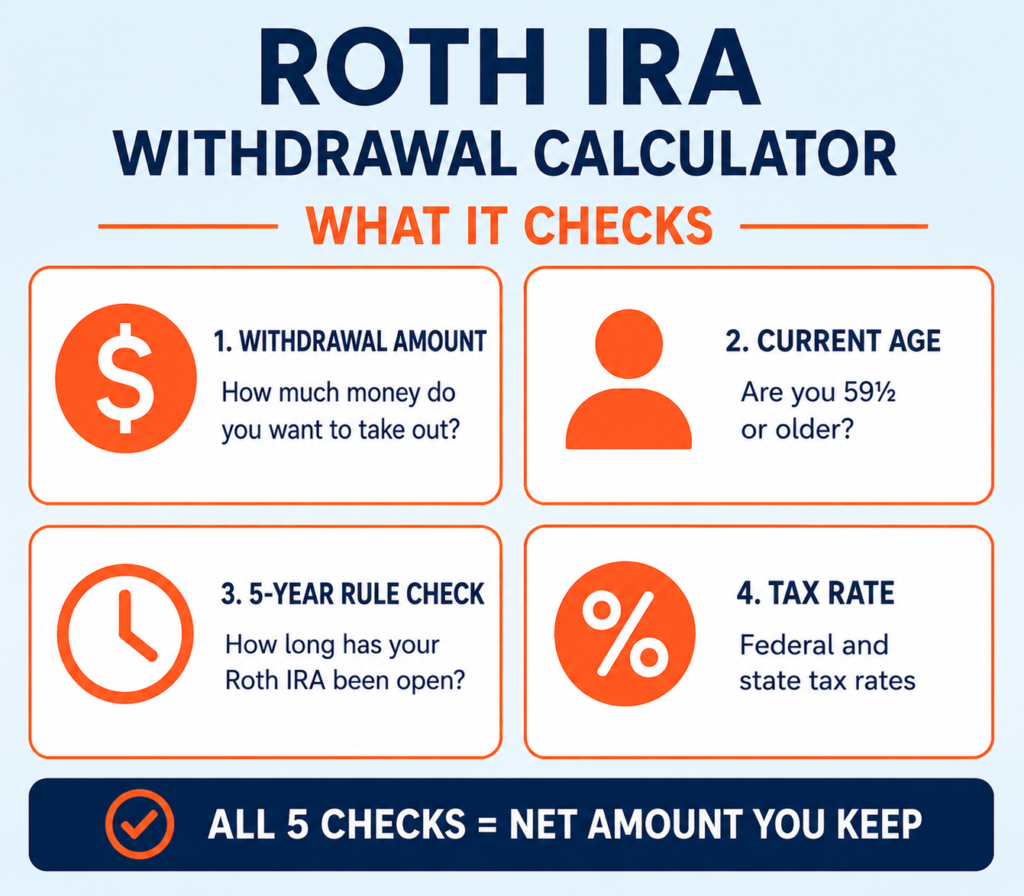
What does this Roth IRA Withdrawal Calculator check?
To figure out what you’d actually walk away with, the calculator needs a few details:
The Order Money Comes Out of a Roth IRA
A lot of people assume the IRS taxes withdrawals proportionally, part contribution, part earnings. It doesn’t. Roth IRA withdrawals follow a specific order set by the IRS:
This is why many people can withdraw a fairly large amount from a Roth IRA and still owe nothing, as long as the total stays within what they’ve contributed and converted, without dipping into earnings.
What Is the Roth IRA 5-Year Rule?
There are actually two different 5-year clocks that come up with Roth IRAs, and mixing them up is a common source of confusion:
When Can You Withdraw Roth IRA Earnings Completely Tax-Free?
You need to meet both conditions at the same time: your account has to be at least 5 years old, and you have to be 59½ or older (or meet a separate qualifying event, like disability, death, or a first-time home purchase). If both boxes are checked, the earnings portion of your withdrawal is entirely tax-free and penalty-free.
What Happens If You Withdraw Earnings Early?
If you withdraw earnings before meeting the 5-year and age 59½ requirements, that portion of the withdrawal is generally taxed as ordinary income, and hit with an additional 10% early withdrawal penalty on top of that, unless you qualify for an exception.
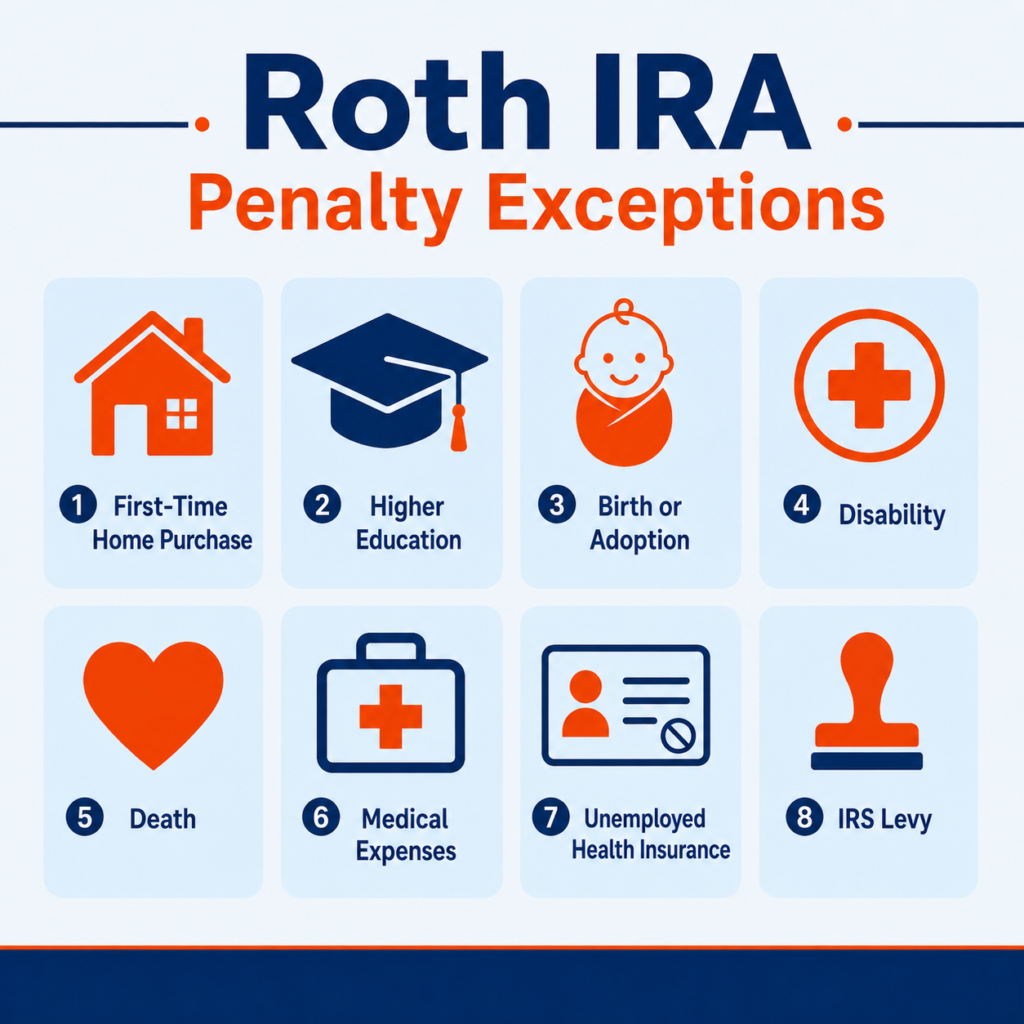
Penalty Exceptions: When You Can Avoid the 10% Penalty
Even if you’re under 59½ or haven’t met the 5-year rule, you may be able to avoid the 10% penalty on earnings (though you may still owe income tax) if the withdrawal is for one of these reasons:
These exceptions typically remove the 10% penalty, not necessarily the income tax owed on the earnings portion. A tax professional can confirm how a specific exception applies to your situation.
Does the Rule of 55 Apply to a Roth IRA?
No. The Rule of 55, which lets you withdraw from a workplace plan penalty-free if you leave your job in or after the year you turn 55, applies to 401(k) and similar employer plans, not IRAs. If you’re comparing early withdrawal rules between an old 401(k) and a Roth IRA, this is one of the biggest differences between the two account types.
Do You Need Tax Withholding on a Roth IRA Withdrawal?
If your withdrawal is fully qualified (tax-free), there’s nothing to withhold, since you don’t owe any tax on it. If you’re taking a non-qualified withdrawal that dips into earnings, your provider may offer to withhold a percentage for taxes upfront, similar to how paycheck withholding works. This is optional on IRA withdrawals in most cases, but choosing not to withhold anything means you’ll need to cover that tax bill yourself when you file.
Roth IRA vs. 401(k) Early Withdrawal Rules
It’s easy to mix up Roth IRA rules with 401(k) rules, since both involve a 10% early withdrawal penalty before age 59½. A few key differences: 401(k) plans often withhold a mandatory 20% for federal taxes on withdrawals, while IRA withholding is typically optional.
The Rule of 55 exception exists for 401(k)s but not IRAs. And a Roth 401(k) doesn’t follow the same contributions-first ordering rule that a Roth IRA does, since employer plans track things differently.
Does a Roth IRA Have Required Minimum Distributions?
No, not during the original owner’s lifetime. This is one of the biggest advantages of a Roth IRA over a Traditional IRA or 401(k). Beneficiaries who inherit a Roth IRA do have their own distribution rules to follow, covered in our inherited Roth IRA and RMD calculator.
Frequently Asked Questions
Conclusion
Whether a Roth IRA withdrawal costs you anything comes down to two things: what you’re withdrawing (contributions versus earnings) and whether you meet the age and 5-year requirements. Use the calculator above with your own numbers to see exactly what you’d keep after taxes and penalties before you make a withdrawal.