Have access to a Roth 401(k) at work and wondering if you still need a Roth IRA too? Enter your numbers below to see how contributing to one, the other, or both could affect your retirement savings.
Enter your details above to compare your options.
ARTICLE BODY (below the tool)
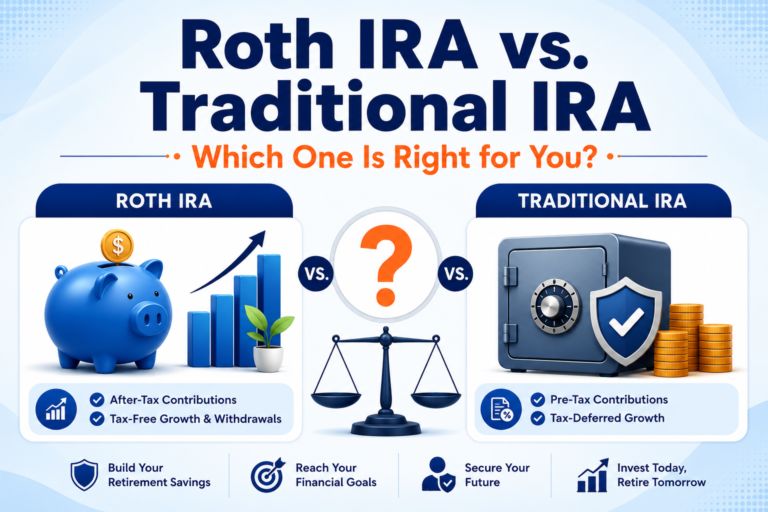
A Roth 401(k) and a Roth IRA offer the same basic tax deal: you contribute after-tax money, it grows tax-free, and qualified withdrawals in retirement are tax-free. The biggest differences are who can open one, how much you can contribute, and whether your income can block you from contributing at all. Many people end up using both.
What’s the Difference Between a Roth 401(k) and a Roth IRA?
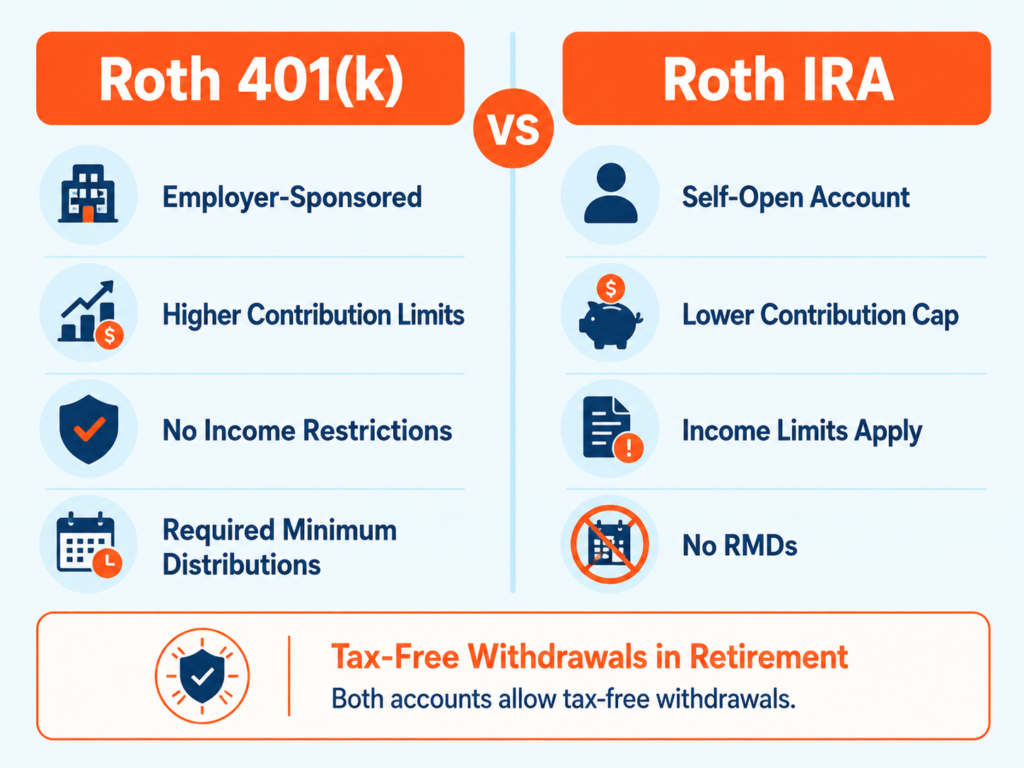
Both accounts tax your money the same way, up front, so your withdrawals in retirement are tax-free. Where they differ is access, contribution room, and income rules.
A Roth 401(k) only exists if your employer offers one, and it lets you contribute far more each year. A Roth IRA is something anyone with earned income can open on their own, but it comes with an income limit and a much smaller contribution cap.
Roth 401(k) vs. Roth IRA: Side-by-Side Comparison
|
Feature |
Roth 401(k) |
Roth IRA |
|
Who can open one |
Only available if your employer offers it |
Anyone with earned income |
|
2026 contribution limit |
$24,500 ($32,500 if 50+; $35,750 if 60-63) |
$7,500 ($8,600 if 50+) |
|
Income limits to contribute |
None |
Yes, phases out at higher incomes |
|
Employer match |
Possible, may go into a separate pretax account |
None, though a few brokers offer incentive matches |
|
Investment choices |
Limited to your plan’s menu |
Any investment your broker offers |
|
Early withdrawal of contributions |
Usually taxed and penalized |
Always tax- and penalty-free |
|
Required minimum distributions |
None, as of Secure 2.0 |
None |
Can You Contribute to Both a Roth 401(k) and a Roth IRA?
Yes. These are two separate contribution limits, so maxing out one doesn’t use up any room in the other. As long as you qualify for the Roth IRA based on your income, you can contribute the full amount to both accounts in the same year.
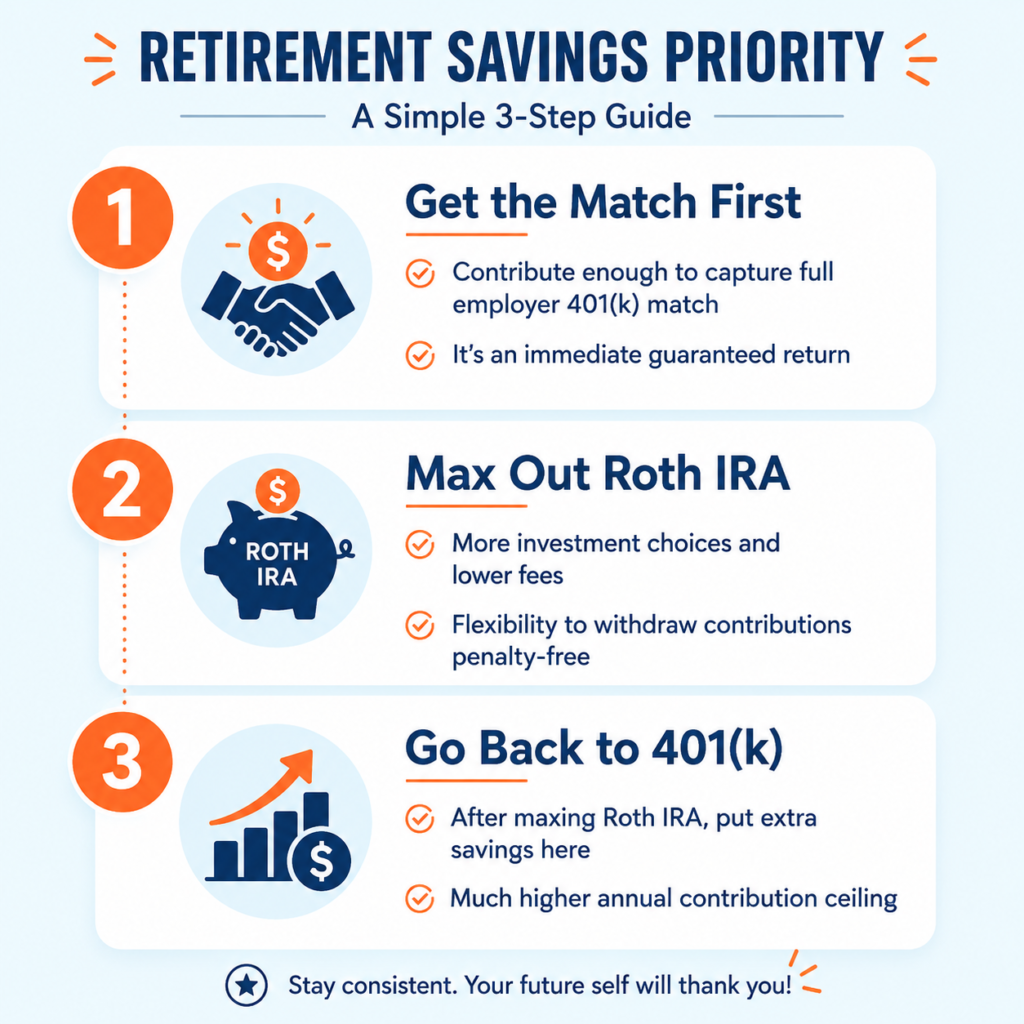
Should You Max Out Your 401(k) or Your Roth IRA First?
A common order that works well for most people:
Not sure how much room you have left in your Roth IRA this year? Check our Roth IRA contribution calculator for your exact limit.
What If Your Income Is Too High for a Roth IRA?
This is one of the main reasons a Roth 401(k) is valuable: it has no income limit. If your income puts you above the Roth IRA phase-out range, a Roth 401(k) through your employer lets you keep contributing to a Roth-style account regardless of how much you earn. High earners who don’t have access to a Roth 401(k) often use a backdoor Roth IRA conversion instead.
A New Rule for High-Earner Catch-Up Contributions
Starting in 2026, a Secure 2.0 rule requires that if you earned more than $150,000 in wages from your employer the previous year, any age-50-or-older catch-up contributions to a workplace plan like a 401(k) must go in as Roth contributions, not pretax. If this applies to you, part of your 401(k) savings will end up in a Roth 401(k) whether you planned for it or not, which is worth knowing when you’re mapping out your overall Roth strategy.
Using a 401(k) and a Roth IRA Together
A simple way to think about combining the two: your 401(k) is where you capture the employer match and put away larger amounts, while your Roth IRA is where you get more control over investment choices and keep some money accessible without penalty if life happens. Together, they cover more retirement savings ground than either account could on its own, and splitting contributions between both is a common, low-effort way to build tax diversification into your plan.
What About a Roth 403(b) or 457(b)?
Roth 403(b) plans (common for teachers, hospital workers, and nonprofit employees) and Roth 457(b) plans (common for government employees) work almost identically to a Roth 401(k): same 2026 contribution limit of $24,500 ($32,500 at 50+), same after-tax, tax-free-withdrawal structure, and the same lack of an income limit. If your employer offers one of these instead of a 401(k), the comparison against a Roth IRA works the same way.
Roth IRA vs. a Regular Brokerage Account
A taxable brokerage account isn’t a retirement account at all; it’s just an investment account with no contribution limit, no income limit, and no special tax treatment. You’ll typically owe tax each year on dividends and capital gains. The trade-off for that flexibility is that a Roth IRA’s tax-free growth usually wins out for money you don’t need before retirement. At the same time, a brokerage account makes more sense for savings you might need sooner or if you have already maxed out your Roth options for the year.
Frequently Asked Questions
Conclusion
A Roth 401(k) and a Roth IRA aren’t competing options so much as two tools that work well together, one for higher contribution limits and an employer match, the other for flexibility and investment choice. Use the calculator above to see how splitting your savings between the two could play out, and check our Roth IRA calculator to project your Roth IRA balance on its own.